Oscillatory flow reactors (or oscillatory baffle reactors) drive a primary
reagent stream through a tube while a second reagent is injected, creating a
chemical reaction between the two. An oscillating piston sloshes the primary
stream back and forth through an insert geometry to promote mixing.
Currently, oscillatory flow reactors are used in the manufacture of
pharmaceuticals and fine chemicals — from paracetamol to cancer medication.
The commercial case
Economics
Improved yields
Thermal Cascade's redesign of this device promotes the desired reaction path,
leading directly to improved yields or savings from reduced purification
costs.
Retrofittable
The design allows for retrofitting existing devices, with 3D-printable mixing
cartridges made to slot in, alongside changes to piston operation.
Designed per duty
Optimal operation and cartridge inserts depend on the exact duty and reaction
performed.
What we design for
Two reaction families
Selectivity reactions
In competitive–consecutive chemistry, the product formed from our two
reagents can go on to form an unwanted by-product if it reacts with one of
those two reagents — i.e. A + B → R, then R + B → S, or
R + A → T. High local concentrations of a single reagent (poor mixing)
are the main cause of these unfavourable reactions. We use physics and
inverse-design principles to improve mixing.
Examples include nitrations, halogenations, diazotisations and azo couplings,
organometallic additions, and fast ionic polymerisations.
Crystallisation & precipitation reactions
This is the main current use of this reactor. It requires correct levels of
supersaturation of reactants, whilst also ensuring peak shear and thermal
dissipation are low — which equally suits other shear-sensitive products
such as flocs, cells and emulsions. We design for these duties separately.
Quench and neutralisation steps also benefit from smooth, edge-free flow.
The mechanism
Feed with the rhythm, not against it
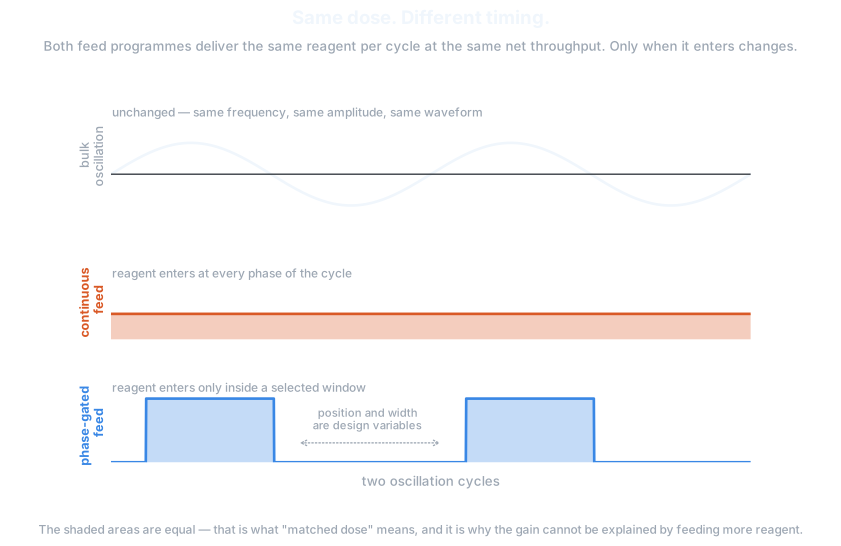
Reagent B is injected into the main flow of reagent A in pulses according to the waveform of
reagent A's oscillation: we time injection with the sloshing. In practice it is a pump programme and a sync signal;
a passive, electronics-free version is also possible, using a pressure-actuated one-way element
opened by the oscillating pressure at the feed port.
The result
Timing beats throughput
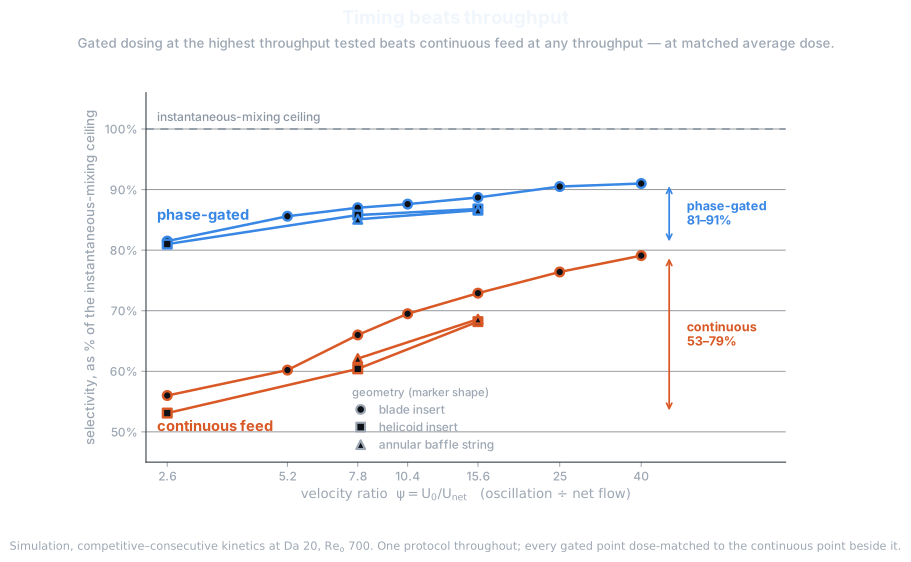
In simulation, phase-gated dosing held about 81–91% of the
instantaneous-mixing ceiling at every operating point and internals
configuration tested, while continuous feed reached at most about
79% at any velocity ratio up to ψ = 40. Pulse dosing at the highest
throughput tested still beat continuous feed at any throughput — at matched
time-averaged dose.
The operating window
One dial trades throughput for quality
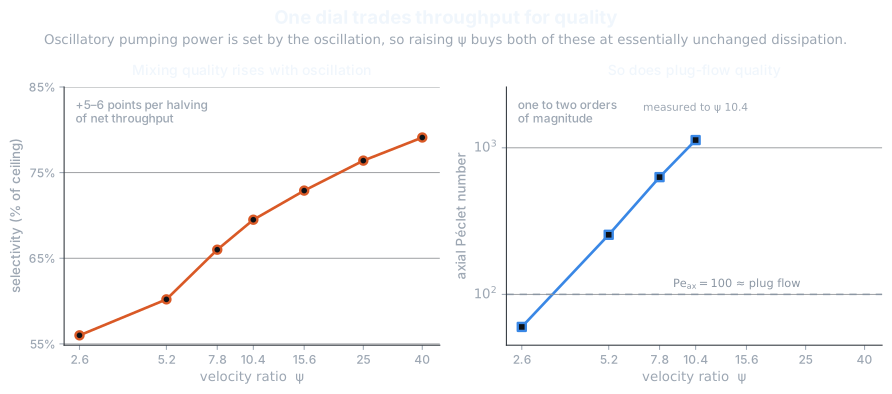
Raising the ratio of the sloshing motion to the net velocity of fluid through
the pipe (ψ) buys mixing quality and plug-flow quality together, at essentially
unchanged dissipation. However, lowering throughput reduces the net output of
product.
The hardware
A one-piece cartridge
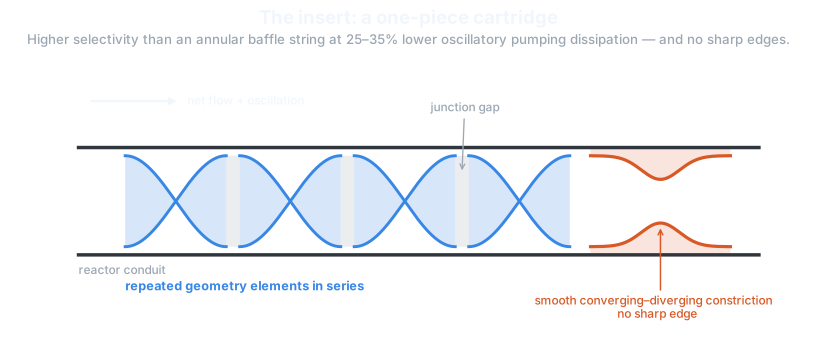
Mixer inserts are printable cartridges of multiple elements in series, ending
in a smooth converging–diverging constriction with no sharp edges. The
insert differs for crystallisation and selectivity duties: purely
mixing-based optimisation for selectivity, and smoother profiles for
crystallisation to lower peak strain.
Status & evidence. The results on this page come from
time-resolved 3D simulation of the coupled flow and reaction
(competitive–consecutive kinetics at Reo ≈ 700, Da ≈ 20), with every
phase-gated case dose-matched to the continuous case beside it. There is no bench
data yet — an experimental programme is the next step, and we are looking
for a process partner to run it with. The method and insert are the subject of a
filed Australian provisional patent application (patent pending).
Talk to us about a pilot
If you have a selectivity-limited reaction — especially one already running in
an oscillatory or baffled reactor — we'd like to hear about it. Technical
briefings available under NDA.